
10 mistakes to avoid to not ruin a trail run
Trail running is a dream.
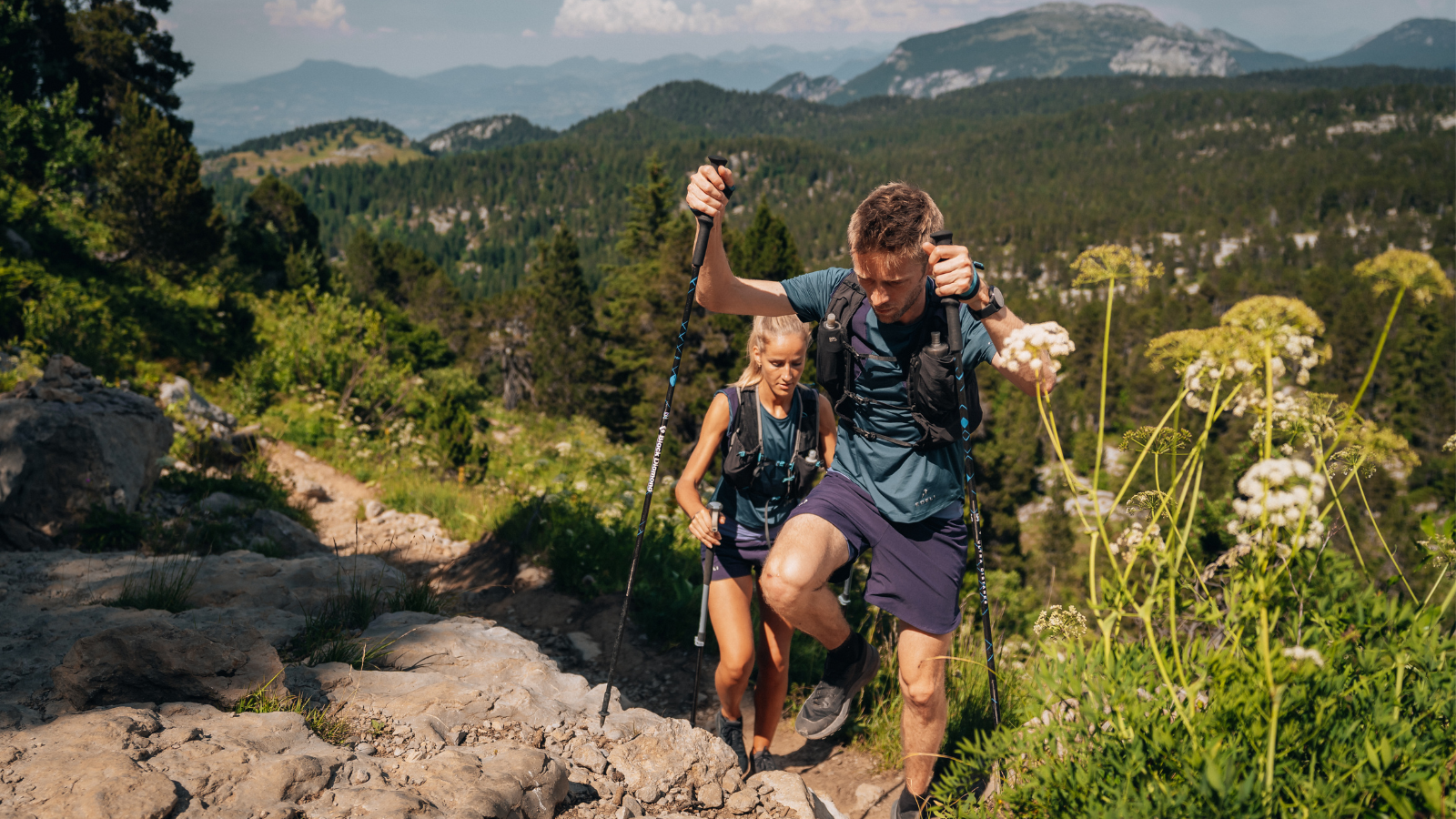
Trails winding through the forest, a sunrise glow over the ridges, the scent of pines after the rain, a summit with breathtaking views. We go running for the effort, of course, but also for that rare feeling of freedom.
And then sometimes, the outing gets complicated: an ascent tackled too quickly that leaves its mark. The weather turns. An empty flask at the wrong moment. A navigation error that extends the run.
Here are 10 of the most common trail running mistakes — and most importantly, how to avoid them to continue enjoying the trails.
1. Starting with inappropriate gear
This is often the first mistake. A pair of road shoes with overly smooth soles on a wet trail, a bouncing pack on descents, shorts without enough storage, a forgotten jacket "because it's sunny at the start"...
In trail running, small details quickly become big problems. The terrain changes constantly. The conditions do too. A two-hour outing can easily turn into a much longer adventure than expected.
The right equipment isn't just "extra" comfort. It's what allows you to keep moving confidently when fatigue sets in or conditions worsen.
Especially in the mountains, it's always better to have:
- a warm layer or a technical base layer,
- shorts or running tights with a large number of pockets
- a lightweight waterproof jacket,
- enough water,
- and something to eat.
2. Starting way too fast
The classic trap. Legs are fresh, heart rate feels easy, the excitement of the start gives you energy... so you speed up.
Mistake. In trail running, the effort rarely takes an immediate toll. The penalty often comes later, at the top of the second climb or after a long technical descent.
Unlike road running, the terrain imposes constant variations:
- re-starts,
- changes in footing,
- elevation changes,
- technical sections,
- demanding descents.
All of this is more energetically demanding. Experienced trail runners don't seem to push themselves at the beginning of a run. They conserve energy. They manage their effort.
Trail running is a school of patience.
3. Increasing volume or difficulty too quickly
Trail running is addictive. After a few great runs, it's easy to start dreaming of long alpine traverses, legendary ultras, or personal challenges. Social media doesn't really help you stay reasonable.
But the body needs time. Muscles progress relatively quickly. Tendons, joints, and deep structures much more slowly.
Wanting to double distances or elevation gain in a few weeks is often the best way to turn a budding passion into a lasting injury. In trail running, endurance is built over months, even years.
It's better to do a little less, a little slower... but for a long time.
4. Underestimating the elevation gain
On paper, 25 kilometers might seem achievable.
But 25 kilometers with 1500 meters of positive elevation gain tells a whole different story. Elevation changes everything:
- effort management,
- muscle fatigue,
- hydration,
- nutrition,
- time spent outdoors.
And most importantly, the actual difficulty of a course. On climbs, the heart rate skyrockets. On descents, the quadriceps absorb thousands of micro-shocks.
The last kilometers of a trail run are never like the first. Before setting off, you should always check:
- the distance,
- the elevation gain (D+),
- the course profile,
- the technicality of the terrain,
- and the estimated time.
In trail running, it's not just the distance that matters. It's also the difficulties that must be overcome to cover it.
5. Poor hydration and nutrition management
The most common mistake? Waiting until you're hungry or thirsty.
When these sensations appear, it's often already too late. Energy dips quickly in trail running, especially with heat, elevation gain, or long outings. And unlike a city run, there's often no faucet, fountain, or store along the way.
You have to anticipate. Drink regularly, in small amounts. Eat before fatigue sets in. Alternate sweet and savory on long runs. And above all: test your nutrition during training.
Poorly tolerated nutrition can ruin an entire run.
6. Neglecting strength training
Trail running doesn't just demand cardio. Downhills put enormous strain on the quadriceps. Ankles must remain stable on uneven terrain. Long climbs fatigue the calves and hips.
Without strength training, the body often ends up struggling. Core strength, leg work, mobility, and balance exercises are almost as important as accumulated kilometers. Strength training allows you to be:
- more efficient,
- more stable,
- more technically relaxed,
- and above all, to reduce the risk of injury.
A strong trail runner fatigues less quickly.
7. Forgetting to check the weather
In the mountains, the weather can change abruptly. A blue sky at the start guarantees absolutely nothing two hours later. The wind can pick up. The temperature can drop. Fog can descend in minutes. And when you're far from everything, the atmosphere can become much less pleasant very quickly.
Checking the weather before a run should become a systematic reflex. Sometimes, the best choice is simply to postpone.
8. Starting without preparing your route
Completely improvising a run in unknown territory is rarely a good idea. In trail running, a wrong turn can quickly:
- considerably lengthen the course,
- deplete water reserves,
- and turn a controlled outing into a major struggle.
Preparing your route allows you to better manage your effort and anticipate difficult sections:
- long climbs,
- exposed sections,
- possible aid stations,
- water points,
- any shortcuts.
Today, an offline GPS track on your phone or watch can prevent many problems.
9. Not anticipating the unexpected
A twisted ankle. A thunderstorm. A fall. A navigation error. Hypoglycemia.
Trail running remains an outdoor activity, sometimes far from any immediate help. Anticipating doesn't mean being worried or anxious. It means being prepared.
Before a long run, it's best to:
- leave with a charged phone,
- inform someone of your route,
- and avoid overly isolated areas when running alone.
A few simple precautions can make a huge difference.
10. Neglecting recovery
Trail running is deeply fatiguing. Muscles and joints take a lot of strain, especially after long runs or technical descents. Wanting to push on without recovery is often counterproductive.
Progress happens during rest:
- sleep,
- rest days,
- nutrition,
- active recovery,
- and lighter training weeks.
Knowing when to slow down is part of training.
The most important thing: how to enjoy it
By constantly checking your watch, pace, or elevation gain, you sometimes forget the essentials. Trail running is also about:
- looking up,
- observing the light,
- gazing at the peaks around you,
- encountering an animal around a bend in the trail,
Running in nature is a privilege, a moment somewhat outside of time and daily life. So, every now and then, look around you, even if it means slowing down a bit.
It's often these moments, these images, that stay with us.
Happy run.



Leave a comment
This site is protected by hCaptcha and the hCaptcha Privacy Policy and Terms of Service apply.